
Residential artificial turf: the complete GTA homeowner guide
Everything in one place: what artificial turf is, when it fits, how to specify the system, what happens below the surface, how to plan for heat and pets, what care remains, how to compare cost, and which questions deserve a written answer.
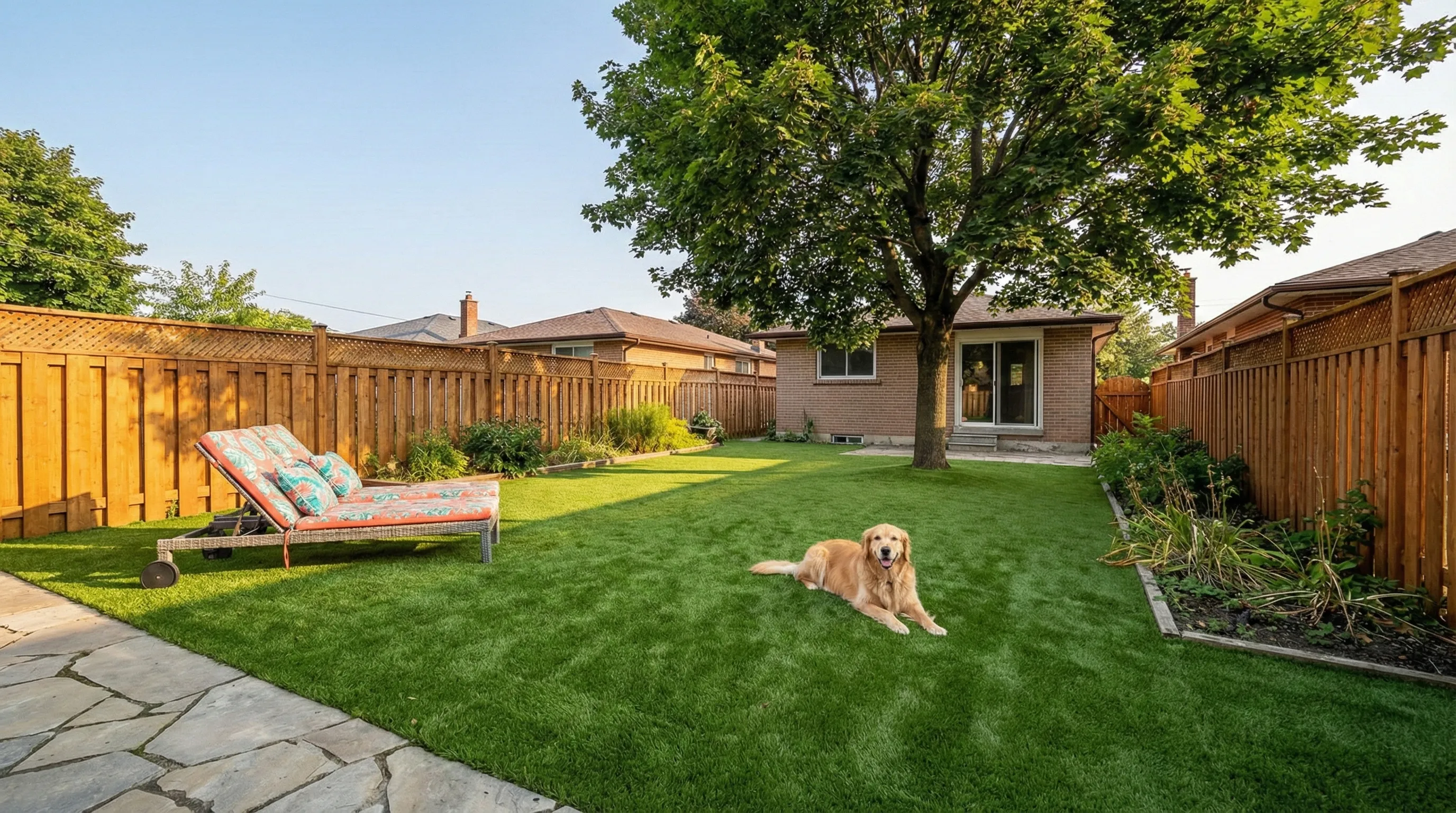
1. The quick answer
Residential artificial turf is a synthetic surface installed over a prepared base. It can be useful where a household wants a consistently usable surface, has a specific mud or wear problem, or cannot maintain natural turf in the existing conditions. It is not maintenance-free, automatically cooler, automatically permitted, or a universal replacement for living landscape.
The responsible decision is a system-and-site decision. Compare the proposed turf, infill, base, drainage, edging, installation scope, care requirements, product documents, workmanship terms, and property rules together.
2. What the system includes
The visible “grass” is only one layer. Ask for each item in the table to be named in the proposal.
| Layer or element | Purpose | Questions to document |
|---|---|---|
| Synthetic turf | Visible fibres, backing, colour blend, pile, and surface feel. | Exact SKU, product sheet, intended use, UV/temperature information, care limits, and manufacturer warranty. |
| Infill | Supports fibres and influences feel, weight, movement, and maintenance. | Material, amount, SDS or supplier information, cleaning guidance, and whether any performance claim is SKU-specific. |
| Base aggregate | Provides a shaped, compacted foundation. | Existing soil, excavation depth, aggregate type, lifts, compaction, finished slope, and exclusions. |
| Drainage path | Moves water through the surface, base, soil, outlet, or approved collection system. | Low points, outlets, downspouts, soil, boundary conditions, heavy-rain assumptions, and maintenance responsibilities. |
| Edging and transitions | Defines the perimeter and connects turf to paths, gardens, patios, fences, and buildings. | Edge material, restraint, trip risks, settlement allowance, tree-root limits, and adjacent-surface transitions. |
| Seams and installation | Turns rolls and components into a finished surface. | Seam layout, joins, fasteners, brushing, cleanup, schedule, access, change orders, and completion records. |
3. When residential turf fits—and when it may not
Situations where it may help
- A defined area repeatedly becomes muddy or worn because of traffic, pets, shade, or use patterns.
- A household wants a predictable-looking surface for a specific use and accepts synthetic materials and routine care.
- A small or difficult-to-mow area needs a deliberate surface treatment alongside planting, patio, or drainage work.
- A putting or practice area needs a purpose-designed surface rather than a general lawn product.
Situations that deserve a different answer
- The project would remove required soft landscaping or living planting without checking local rules.
- The site has unresolved grade, runoff, foundation, utility, soil, or retaining-wall problems.
- The main goal is biodiversity, cooling, infiltration, or habitat; living landscape may serve those goals better.
- The household expects zero care, zero heat, zero replacement, or a universal health/environmental guarantee.
- The proposed product or infill cannot be identified, documented, cleaned, repaired, or supported after installation.
4. Site review and design
A site review should document how people, water, materials, tools, and future maintenance move through the property. Photograph existing conditions and note what is outside the quoted scope.
- Measure the area. Record shape, levels, gates, stairs, access, furniture, trees, fences, downspouts, and adjacent surfaces.
- Understand the existing problem. Is the issue mowing, mud, shade, compaction, pets, construction damage, drainage, or an unsuitable use pattern? The solution depends on the cause.
- Set the finished elevation. Explain how the new surface meets doors, steps, thresholds, patios, retaining walls, gardens, and fences.
- Plan the visual system. Review a physical sample, blade profile, colour blend, pile, infill, seam direction, edge details, and planting context.
- Design for use. Leave room for furniture, play, pet routines, snow, cleaning, access panels, and any future work.
5. Typical installation sequence
Exact work varies by site, but a transparent sequence generally explains:
- Confirm scope, access, property requirements, utility information, product selection, and written assumptions.
- Protect the work area and remove agreed materials, vegetation, debris, or existing surface.
- Excavate and dispose of unsuitable material within the documented scope.
- Place, shape, moisture-condition as appropriate, and compact the base in controlled lifts.
- Resolve drainage, low points, outlets, edges, transitions, and finished elevations.
- Lay, orient, cut, join, stretch, and secure the turf according to the selected system.
- Install specified infill, brush the surface, complete edges, clean the site, and record completion photos.
- Provide product information, care instructions, invoice, applicable warranty documents, and the process for future questions.
Weather, access, buried conditions, material availability, homeowner decisions, and municipal or utility requirements can change a schedule. A proposal should explain how changes are discussed and documented.
6. Drainage, grading, and runoff
Drainage is a site-system issue, not a single turf specification. Water may move through backing and infill, into the base, through native soil, to a drain, or to an approved collection path. Soil, slope, low points, downspouts, foundations, fences, neighbouring grades, and outlets all matter.
Toronto’s guidance emphasizes responsible on-site water management and maintaining catch basins, swales, and drainage features. It also warns against directing water toward buildings, sidewalks, roads, City land, or places where it could damage structures. Read the City’s grading, drainage, runoff, and downspout guidance for the current municipal position.
Questions for the written scope
- Where does water go during a heavy rain?
- What happens at the lowest point and at each property boundary?
- Are downspouts, catch basins, swales, or drains involved?
- What soil, excavation, compaction, outlet, or maintenance assumption limits the answer?
- Is the proposed work changing grade or directing water toward another property?
7. Heat, children, pets, and safety
Artificial surfaces can become hot in summer. Toronto Public Health advises heat precautions, shade, water, hygiene, supervision of small children, and preventing ingestion or tracking of infill. Its guidance also recommends addressing heat absorption, chemical content, water capture, drainage, sanitation, and maintenance when selecting and operating artificial turf systems. Review the current Artificial Turf in Toronto guidance; it was modified March 13, 2025.
Practical household controls
- Provide shade and drinking water; check surface conditions before barefoot play or pet use during hot weather.
- Supervise young children and pets; do not allow chewing or intentional ingestion of turf or infill.
- Wash hands after use, clean abrasions promptly, and avoid eating on the surface.
- Keep cleaning products, pesticides, solvents, oils, and hot objects within the product’s care limits.
- Ask for exact-SKU supplier declarations or test documents for any environmental or safety claim. Do not treat “non-toxic,” “PFAS-free,” “lead-free,” or “antimicrobial” as universal conclusions without scope-specific evidence.
8. Care through the seasons
| Season | Routine | Watch for |
|---|---|---|
| Spring | Remove branches and winter debris, inspect seams and edges, rinse where appropriate, and check low points. | Settlement, heaving, blocked outlets, displaced infill, moss, weeds at edges, and damage from snow equipment. |
| Summer | Remove leaves and spills, rinse pet areas as directed, brush high-traffic areas if the care guide allows, and manage shade and heat. | Hot surfaces, odour from missed cleaning, furniture indentation, barbecue grease, and chemical spills. |
| Autumn | Clear leaves before they decompose, clean gutters and downspouts, and inspect transitions before snow. | Organic buildup, blocked drainage, staining, and branches that can damage or shade the surface. |
| Winter | Follow the selected product’s snow and ice guidance; use only approved tools and de-icers. | Metal blades, aggressive scraping, salt or chemical limits, freeze-thaw movement, and heavy snow storage. |
“Low maintenance” means a different routine, not no routine. Keep the product care guide with the proposal and ask which cleaning products, tools, infill top-ups, and repairs are permitted.
9. Environmental tradeoffs
Artificial turf can reduce mowing or watering in some use cases, but it also introduces synthetic materials, heat retention, surface runoff questions, replacement, and end-of-life considerations. A credible decision weighs those tradeoffs against the actual alternative: natural turf, planting, mulch, paving, a rain garden, or a mixed landscape.
- Heat: synthetic surfaces can retain heat; shade, planting, orientation, material choice, and use rules matter.
- Water: a surface may need less routine irrigation, but the complete site still needs a responsible runoff and drainage path.
- Habitat: replacing living planting can reduce food and nesting opportunities for pollinators; retain or add appropriate plants where possible.
- Materials: request the exact turf, backing, infill, SDS or declarations, and any available test documents rather than relying on a blanket label.
- End of life: ask how the selected system can be removed, separated, reused, recycled, or disposed of in the relevant jurisdiction. Do not assume every product has the same route.
Toronto Public Health specifically recommends considering natural vegetation, minimizing high-heat and impervious surfaces, and addressing water capture, drainage, sanitation, chemical content, and maintenance in system selection.
10. Cost and lifecycle thinking
Installed cost depends on area, access, excavation, soil, base, grading, drainage, edges, turf, infill, labour, disposal, taxes, and options. The useful output is an itemized project scope—not a universal square-foot number or guaranteed payback.
For a fair comparison, record:
- Measured area, access, demolition, excavation, disposal, base, drainage, edging, turf, infill, labour, cleanup, taxes, and optional items.
- Natural-grass mowing, watering, service, equipment, disposal, homeowner time, and expected ownership period.
- Turf care, repairs, infill, replacement timing, snow handling, and any optional service.
- Which inputs are estimates, who supplied them, what date/geography they represent, and how the homeowner can change them.
See the dedicated artificial turf cost guide for an editable-assumptions framework.
11. GTA planning checks
Do not assume artificial turf is automatically permitted, soft landscaping, permeable, or a way around a driveway or parking rule. Requirements can depend on municipality, zoning, lot dimensions, yard location, existing approvals, grading, trees, utilities, easements, conservation controls, and project scope.
Toronto’s current public guidance says artificial turf is not considered soft landscaping and does not count toward certain soft-landscaping requirements; different requirements can apply by lot and zoning. Read the City’s turfgrass and artificial-turf guidance and confirm the address-specific position with Toronto Building. For Vaughan, Brampton, Mississauga, and other municipalities, use the municipality’s current sources and ask for an address-specific review.
12. Contractor, proposal, and warranty questions
- What legal entity is contracting, and who is responsible for the scope?
- Which exact turf and infill SKUs are proposed, and can I review current manufacturer documents?
- What is included, excluded, optional, assumed, or subject to a written change?
- How are access, excavation, unsuitable soil, buried conditions, drainage, and disposal handled?
- What are the product warranty terms, and what separate workmanship terms apply?
- What care, snow, furniture, pet, cleaning, and repair responsibilities remain with the homeowner?
- What records will I receive at completion?
- How do I raise a concern, and who acknowledges and resolves it?
A dated certificate, badge, rating, years-of-experience claim, warranty duration, or performance promise should be current, scoped to the legal entity or SKU, and available for review before it is relied upon.
13. Homeowner FAQ
Does artificial turf eliminate maintenance?
No. It changes the routine: debris removal, rinsing, pet-area cleaning, inspections, brushing where appropriate, infill care, seasonal work, and repairs can remain.
Can artificial turf flood?
Any surface can experience water problems if the site, soil, grades, outlets, boundaries, or maintenance are unsuitable. Drainage must be evaluated as a complete property-specific system.
Will it stay cool in summer?
No universal cooling promise is reliable. Synthetic surfaces can become hot; provide shade and water, supervise use, and follow current public-health and product guidance.
Is it safe for dogs and children?
Safety depends on the selected materials, installation, heat, cleaning, supervision, and use. Do not allow chewing or infill ingestion, and request exact-product documentation for any safety claim.
Will weeds grow through it?
Weeds can appear at seams, edges, cracks, or from debris and airborne seeds. Site preparation, edge detailing, cleaning, and the permitted care routine matter.
Does turf count as soft landscaping?
Not automatically. Toronto’s guidance says artificial turf is not soft landscaping for the cited requirements. Other municipalities and properties may differ, so confirm the current address-specific rules.
Can I put a patio, pool, fire feature, or furniture on it?
Possibly, but the load, heat, access, fire-safety, drainage, manufacturer limits, and installation details must be designed together. Do not assume a general turf product supports every feature.
How long will it last?
There is no universal lifespan. Traffic, UV exposure, installation, drainage, cleaning, damage, product, and maintenance all matter. Review the current SKU-specific documentation.
Can I install it myself?
Small projects may be technically possible, but excavation, compaction, grading, seams, edges, drainage, tools, disposal, and warranty requirements create meaningful risk. Compare the full scope and records, not only the roll.
What happens when it needs replacement?
Ask before buying: who removes it, what happens to each material, what disposal or recycling route exists locally, and whether the product or installer provides a documented path.
14. Decision checklist
- ☐ I know the problem I am trying to solve and the alternatives I considered.
- ☐ I checked municipal, zoning, grading, drainage, tree, utility, easement, and conservation requirements.
- ☐ I reviewed a physical sample and relevant completed-project photos.
- ☐ I have the exact product and infill information for the proposed system.
- ☐ The proposal identifies preparation, drainage, edges, transitions, access, exclusions, taxes, and changes.
- ☐ I understand heat, cleaning, pet/child supervision, snow, furniture, repair, and replacement responsibilities.
- ☐ I have separate product and workmanship warranty documents in writing.
- ☐ I know who will answer a future question and how a concern is documented.
Primary sources and review notes
This guide is educational and does not replace municipal, legal, engineering, medical, product, or contract advice. Source links were checked July 21, 2026:
- City of Toronto Public Health: Artificial Turf in Toronto (modified March 13, 2025)
- City of Toronto 311: grading, drainage, runoff, and downspouts
- City of Toronto: soft landscaping and artificial turf (modified July 9, 2026)
- YardGuard’s GTA property-planning guide, which links to current municipal sources for Toronto, Vaughan, Brampton, and Mississauga.
Product-specific claims must be supported by current manufacturer documentation for the exact SKU. Municipal rules and product documents can change; review this guide before relying on it for a project decision.